
Restaurant Marketing in Dubai: How to Attract More Customers in 2026
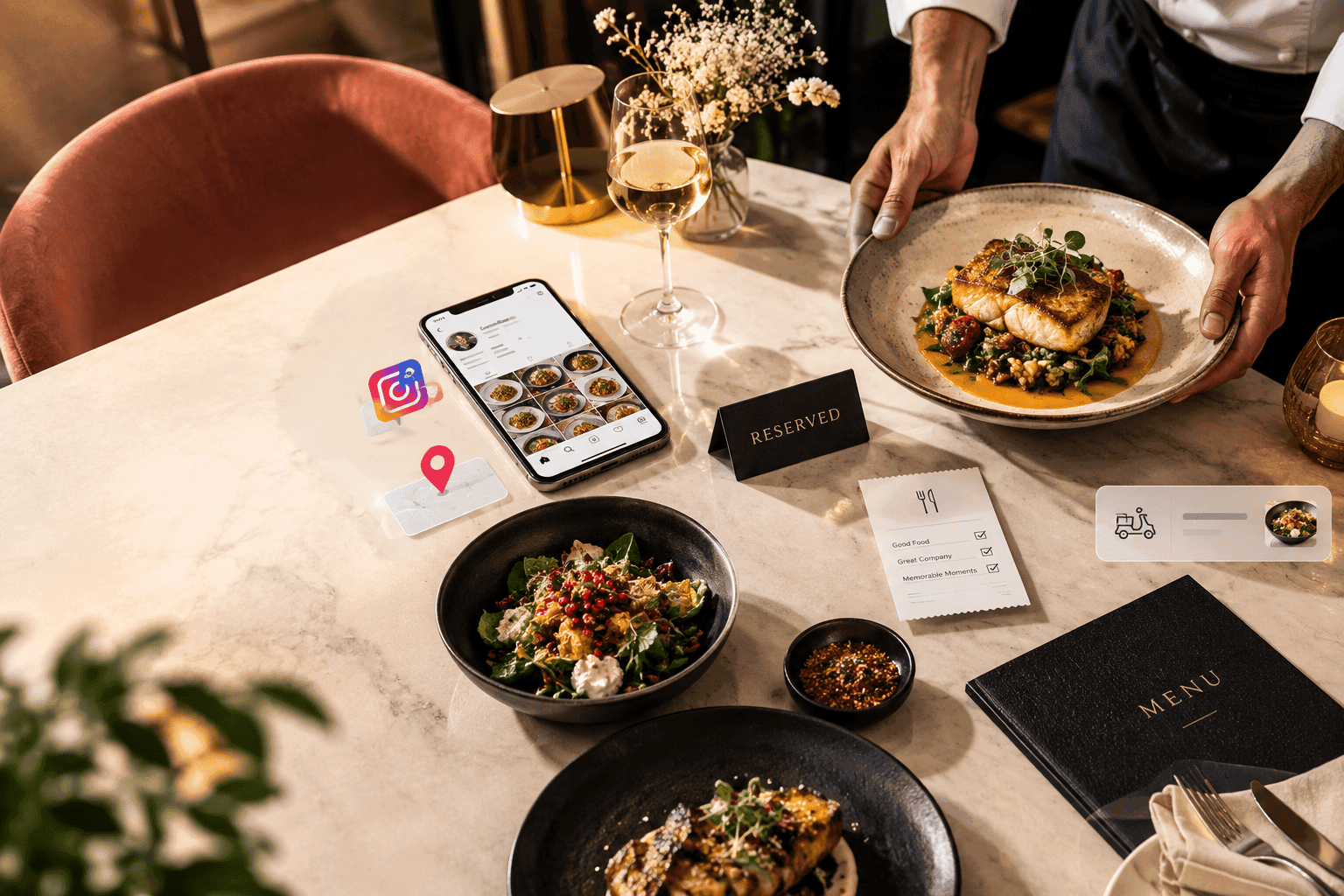
Dubai’s restaurant market is highly competitive. A new café, restaurant, lounge or food concept can open in one neighbourhood while dozens of established businesses are already competing for the same customers.
For restaurant owners, great food is only part of the equation.
People need to discover your restaurant, see what it offers, trust the experience, check the menu, compare alternatives and finally decide to visit or order.
That is where restaurant marketing becomes important.
A strong restaurant marketing strategy in Dubai combines social media, local SEO, Google Maps, paid advertising, food content, influencer marketing, online reviews, websites, delivery channels and customer retention.
According to Dubai’s Department of Economy and Tourism, social media plays an important role in restaurant discovery, with its Dubai Gastronomy Industry Report noting that 70% of UAE diners consult social media before choosing a restaurant.
At the same time, Google remains extremely important for high-intent searches such as restaurants near me, best Italian restaurant in Dubai, restaurants in Dubai Marina or best brunch near me.
For a restaurant, the goal is therefore not simply to “get followers.”
The goal is to be discovered when people are ready to eat.
What Is Restaurant Marketing?
Restaurant marketing is the process of promoting a restaurant, café, lounge, cloud kitchen or F&B brand to attract new customers, increase reservations and orders, encourage repeat visits and build long-term brand awareness.
Modern restaurant marketing can include:
- Social media marketing
- Instagram and TikTok content
- Restaurant SEO
- Google Maps optimisation
- Google Business Profile management
- Google Ads
- Meta Ads
- Influencer marketing
- Food photography and videography
- Online reputation management
- Website development
- Menu optimisation
- Delivery platform marketing
- WhatsApp marketing
- Email marketing
- Loyalty and retention campaigns
- Event and seasonal marketing
- Local content marketing
The most effective strategy depends on the type of restaurant, location, cuisine, price point, audience and business objective.
A fine-dining restaurant in Downtown Dubai should not necessarily use the same marketing strategy as a casual café in JLT or a cloud kitchen serving multiple Dubai communities.
Why Restaurant Marketing in Dubai Is Different
Dubai’s dining audience is extremely diverse.
A restaurant can attract residents, tourists, office workers, families, hotel guests, expatriates and visitors from different countries—all with different dining habits and expectations.
That creates both an opportunity and a challenge.
A customer might discover a restaurant through Instagram, check its Google reviews, look at the menu on its website, compare the location on Google Maps and then make a reservation.
Another customer may discover the same restaurant through a Reel and order through a delivery platform.
Someone else may ask an AI search engine:
“What are the best restaurants for a business dinner in Dubai?”
Your marketing needs to account for all of these discovery journeys.
1. Social Media Marketing for Restaurants
For many restaurants, social media is the first place potential customers experience the brand.
The challenge is that simply posting food photographs is no longer enough.
Your content needs to communicate:
What does the food look like?
What does the restaurant feel like?
What makes it different?
Who is it for?
Why should someone visit today?
Content that restaurants can use
A strong restaurant social media strategy can include:
- Food preparation videos
- Chef stories
- Signature dishes
- Behind-the-scenes content
- Restaurant ambience
- Customer experiences
- Staff stories
- New menu launches
- Seasonal dishes
- Special offers
- Events
- Live entertainment
- User-generated content
- Influencer visits
- Customer reviews
- Short recipe or ingredient stories
Short-form video is particularly useful for showing the experience rather than simply describing it.
A 15-second video showing a dish being finished at the table can communicate more than several paragraphs of advertising copy.
2. Restaurant SEO in Dubai
SEO for restaurants is different from SEO for many traditional businesses.
Restaurant customers often search with location, cuisine, occasion and proximity.
Examples include:
- Restaurants in Dubai Marina
- Restaurants in Downtown Dubai
- Italian restaurant Dubai
- Indian restaurant Dubai
- Best restaurants in JLT
- Cafés near me
- Best brunch in Dubai
- Restaurants near Business Bay
- Family restaurants Dubai
- Fine dining restaurants Dubai
- Best seafood restaurant Dubai
- Restaurants open now
Your website should therefore provide clear information around the searches your customers actually make.
Important restaurant SEO pages
Depending on the business, a restaurant website could have:
- Homepage
- Menu
- About
- Reservations
- Location
- Contact
- Private dining
- Events
- Catering
- Delivery
- Cuisine-specific pages
- Location pages
- Blog or dining guides
Do not create dozens of almost identical location pages simply to target keywords.
Each page should provide useful information for a real customer.
3. Google Maps Marketing for Restaurants
For local restaurants, Google Maps can be one of the most valuable digital discovery channels.
Google explains that Business Profiles can appear across Google Search and Google Maps, allowing restaurants to provide information such as opening hours, menus, photos and other business details.
A restaurant should therefore treat its Google Business Profile as an important part of its marketing presence—not just a listing.
Optimise your Google Business Profile
Make sure your profile has:
- Correct restaurant name
- Accurate address
- Correct phone number
- Opening hours
- Holiday and seasonal hours
- Restaurant category
- Website
- Menu
- Reservation links
- Ordering links where applicable
- High-quality food photographs
- Interior and exterior photographs
- Updated information
- Customer reviews
- Responses to reviews
Google also notes that the categories selected for a Business Profile help connect businesses with relevant searches and can affect local ranking.
For restaurants, this is particularly important because the category should accurately represent what the business actually is.
4. Restaurant Reviews and Reputation Marketing
Before visiting a restaurant, customers often want reassurance.
They look at:
- Google reviews
- Food photographs
- Instagram content
- Customer comments
- Influencer reviews
- Menu prices
- Restaurant ambience
- Recent experiences
This makes reputation management an important part of restaurant marketing.
Restaurants should actively encourage genuine customers to leave reviews and respond professionally to both positive and negative feedback.
Do not treat reviews as something that happens automatically.
Build a process around them.
For example:
Visit → Great experience → Review request → Review → Response → Repeat visit
A positive review can also become marketing content.
5. Paid Advertising for Restaurants
Organic social media can create awareness, but paid advertising allows restaurants to target specific audiences and locations.
A restaurant might run campaigns for:
New restaurant launch
Target people living or working near the restaurant.
Weekend promotions
Promote Friday brunch, Saturday dinner or Sunday family offers.
Seasonal campaigns
Use campaigns around Ramadan, Eid, Valentine’s Day, Christmas, New Year and other relevant occasions.
New menu launch
Promote a new dish or seasonal menu.
Restaurant events
Advertise live music, tasting menus, chef collaborations or special dining experiences.
Retargeting
Reach people who have already interacted with your website, social media or advertising.
The objective should not simply be impressions.
A restaurant should measure outcomes such as:
- Reservations
- Calls
- WhatsApp enquiries
- Website visits
- Menu views
- Online orders
- Directions
- Leads
- Repeat customers
6. Food Photography and Video Marketing
For restaurants, visual content is not an optional extra.
It is part of the product presentation.
People cannot taste the food through their phones.
You have to make them imagine the experience.
Good food photography should communicate:
- Texture
- Portion
- Presentation
- Freshness
- Atmosphere
- Premium quality
- Dining experience
Video can go further.
Show the steam.
Show the sauce being poured.
Show the chef finishing the dish.
Show the table being prepared.
Show the restaurant when it is full.
Show what happens behind the scenes.
Instead of simply saying “Come and try our new menu,” give people a reason to want to experience it.
7. Influencer Marketing for Restaurants
Dubai has a large creator and influencer ecosystem, making influencer marketing attractive for restaurants.
But choosing influencers purely by follower count can be a mistake.
A restaurant should consider:
- Audience location
- Audience demographics
- Engagement quality
- Content style
- Cuisine relevance
- Previous restaurant collaborations
- Authenticity
- Expected deliverables
- Cost
- Trackable results
A creator with 30,000 highly relevant Dubai followers may be more valuable to a restaurant than someone with 500,000 followers whose audience is mostly outside the UAE.
The important question is not:
“How many followers does this influencer have?”
It is:
“Can this creator influence the people we actually want to attract?”
8. Your Restaurant Website Still Matters
Social media may generate discovery, but your website gives customers a destination you control.
A restaurant website should make the important information immediately accessible.
Customers should be able to quickly find:
- Menu
- Location
- Opening hours
- Reservation options
- Phone number
- Delivery options
- Events
- Private dining
- Restaurant story
- Contact information
The website should also be:
- Mobile-friendly
- Fast
- Easy to navigate
- Search-engine friendly
- Secure
- Easy to update
For restaurants with multiple branches, the website should clearly separate locations so customers can find the correct branch.
9. Don’t Depend Entirely on Delivery Platforms
Food delivery has become an important part of the UAE restaurant ecosystem.
Recent UAE data reported by Khaleej Times showed delivery orders rising 15.2% year-on-year in the first half of 2026, with delivery accounting for 30.5% of restaurant orders in the analysed network.
That makes delivery platforms important—but restaurants should also think about building their own customer relationships.
Your marketing strategy can include:
Discovery → Website → Direct enquiry/order → Customer data → Retention
Where appropriate, restaurants can use their own website, WhatsApp, CRM, email or loyalty programme to encourage repeat business.
The objective is not necessarily to abandon delivery platforms.
It is to avoid building your entire customer relationship around somebody else’s platform.
10. WhatsApp Marketing for Restaurants
WhatsApp can be particularly useful for restaurants because communication can be direct and immediate.
Potential use cases include:
- Reservation enquiries
- Event enquiries
- Private dining
- Catering enquiries
- New menu announcements
- Special offers
- Loyalty communication
- Customer service
- Birthday offers
- Repeat-customer campaigns
However, restaurants should avoid turning WhatsApp into a constant promotional channel.
Useful communication will generally perform better than simply sending discounts repeatedly.
11. Restaurant Marketing Should Be Built Around the Customer Journey
One of the biggest mistakes restaurants make is treating every marketing channel separately.
Instead, think about the complete journey.
Stage 1 — Discovery
A customer sees:
Instagram Reel → TikTok → Google Search → Influencer → Google Maps
Stage 2 — Consideration
They check:
Photos → Reviews → Menu → Location → Website
Stage 3 — Decision
They take action:
Reserve → Call → WhatsApp → Order → Visit
Stage 4 — Experience
The restaurant delivers:
Food → Service → Atmosphere
Stage 5 — Retention
The restaurant continues the relationship:
Review → Loyalty → WhatsApp → Email → Next visit
This is where restaurant marketing becomes much more powerful.
You’re not just trying to get someone to visit once.
You’re building a system that can turn a first-time guest into a returning customer.
12. Local SEO + Social Media + Paid Ads Work Better Together
Restaurants sometimes ask:
“Should we do SEO or Instagram?”
In many cases, that is the wrong question.
Each channel serves a different purpose.
| Channel | Main purpose |
|---|---|
| Discovery & visual brand | |
| TikTok | Reach & entertainment |
| Google Search | High-intent discovery |
| Google Maps | Local discovery |
| SEO | Long-term organic visibility |
| Meta Ads | Targeted reach & conversions |
| Google Ads | Capture active search demand |
| Influencers | Trust & awareness |
| Direct communication | |
| CRM/Loyalty | Retention |
| Website | Information & conversion |
The strongest strategy connects these channels instead of operating them independently.
What Should a Dubai Restaurant’s Marketing Budget Focus On?
There is no single budget that works for every restaurant.
A new fine-dining concept, neighbourhood café, cloud kitchen and established restaurant group will have very different requirements.
A practical approach is to divide investment across several areas:
Brand & content
Photography, video, creative design and social media content.
Discovery
SEO, Google Maps, social media and influencer activity.
Customer acquisition
Google Ads, Meta Ads and campaign-specific advertising.
Conversion
Website, reservations, WhatsApp and online ordering.
Retention
CRM, loyalty, email and WhatsApp campaigns.
Instead of asking “How much should we spend on marketing?”, restaurant owners should ask:
“How much does it cost us to acquire a customer, and how often can that customer return?”
That creates a much more useful basis for deciding marketing investment.
Common Restaurant Marketing Mistakes
Posting without a strategy
Posting food photographs every day does not automatically create business.
Focusing only on followers
10,000 followers are not useful if they never visit, order or recommend the restaurant.
Ignoring Google Maps
A restaurant can have a beautiful Instagram account and still be difficult to find through local search.
Using poor food photography
Customers make visual decisions quickly.
Running ads without tracking
If you cannot identify which campaign generates reservations or orders, optimisation becomes difficult.
Ignoring reviews
Reviews influence trust and can affect the customer’s decision.
Depending entirely on influencers
Influencer awareness is useful, but restaurants should also build owned channels.
Forgetting repeat customers
Acquiring a new customer is only the beginning.
How to Build a Restaurant Marketing Strategy in Dubai
A practical restaurant marketing plan can follow these steps:
Step 1: Define your audience
Are you targeting:
- Families?
- Tourists?
- Office workers?
- Young professionals?
- Luxury diners?
- Residents of a particular community?
- Delivery customers?
- Corporate clients?
Step 2: Define your positioning
What makes the restaurant different?
Cuisine alone may not be enough.
Think about:
Food + experience + atmosphere + location + price + occasion
Step 3: Optimise your digital presence
Review:
- Website
- Google Business Profile
- Google Maps
- TikTok
- Delivery platforms
- Reviews
- Reservation process
Step 4: Build a content system
Create recurring content categories instead of deciding what to post every morning.
Step 5: Launch targeted campaigns
Run advertising around specific commercial objectives.
Step 6: Track results
Measure what matters to the business—not vanity metrics alone.
Step 7: Retain customers
Use loyalty, CRM, WhatsApp and email where appropriate to bring customers back.
Restaurant Marketing in Dubai Is About Being Chosen
The restaurant with the biggest advertising budget does not automatically win.
Customers have too many choices.
The restaurants that stand out are the ones that make themselves easy to discover, easy to understand, easy to trust and easy to visit or order from.
That means your restaurant needs more than an Instagram page.
It needs a connected digital presence.
Search gets you discovered.
Social media creates desire.
Reviews build trust.
Your website provides information.
Advertising creates demand.
A good experience creates loyalty.
For restaurants in Dubai, these elements should work together.
How DXB360 Marketing Can Help Restaurants
At DXB360 Marketing, restaurant and F&B marketing can bring together digital marketing, social media management, SEO, web development, creative content, paid advertising, CRM and customer communication as part of one connected strategy.
The focus is not simply on making a restaurant look active online.
It is on building a digital journey that helps customers discover the restaurant, understand the experience, take action and come back again.
Frequently Asked Questions
What is restaurant marketing in Dubai?
Restaurant marketing in Dubai involves promoting a restaurant through channels such as social media, Google Search, Google Maps, SEO, paid advertising, influencers, websites, reviews, delivery platforms and customer-retention campaigns.
What is the best marketing strategy for a restaurant in Dubai?
There is no single strategy for every restaurant. A strong starting point usually combines local SEO and Google Maps, visual social media content, targeted advertising, reputation management and a website designed to make reservations or enquiries easy.
How can I promote my restaurant on Google?
Claim and verify your Google Business Profile, select an accurate business category, keep your information updated, add high-quality photos and menu information, manage reviews and maintain an accurate website. Google specifically recommends keeping business information complete and accurate to improve local visibility.
Is Instagram important for restaurant marketing?
Yes. Restaurant discovery is highly visual, and Dubai’s tourism and gastronomy ecosystem already places significant emphasis on social media content. Dubai’s Gastronomy Industry Report reported that 70% of UAE diners consult social media before choosing a restaurant.
Should restaurants invest in SEO?
Yes, particularly for restaurants targeting local searches, specific cuisines, neighbourhoods, events, catering, private dining and other high-intent queries. SEO can complement Google Maps and social media rather than replacing them.
How can a restaurant get more customers in Dubai?
Start by identifying the audience and commercial objective, then build visibility across Google Maps, Search and social media, create strong food and experience content, use targeted advertising, improve reviews and make reservations or ordering simple.
Final Thoughts
Restaurant marketing in Dubai is no longer just about putting an attractive food photograph on Instagram.
Customers can discover your restaurant through a Reel, search for you on Google, compare reviews, check your menu, look at your location and make a reservation—all within a few minutes.
Your marketing needs to connect those moments.
Be visible. Be discoverable. Be memorable. Make it easy to choose you.