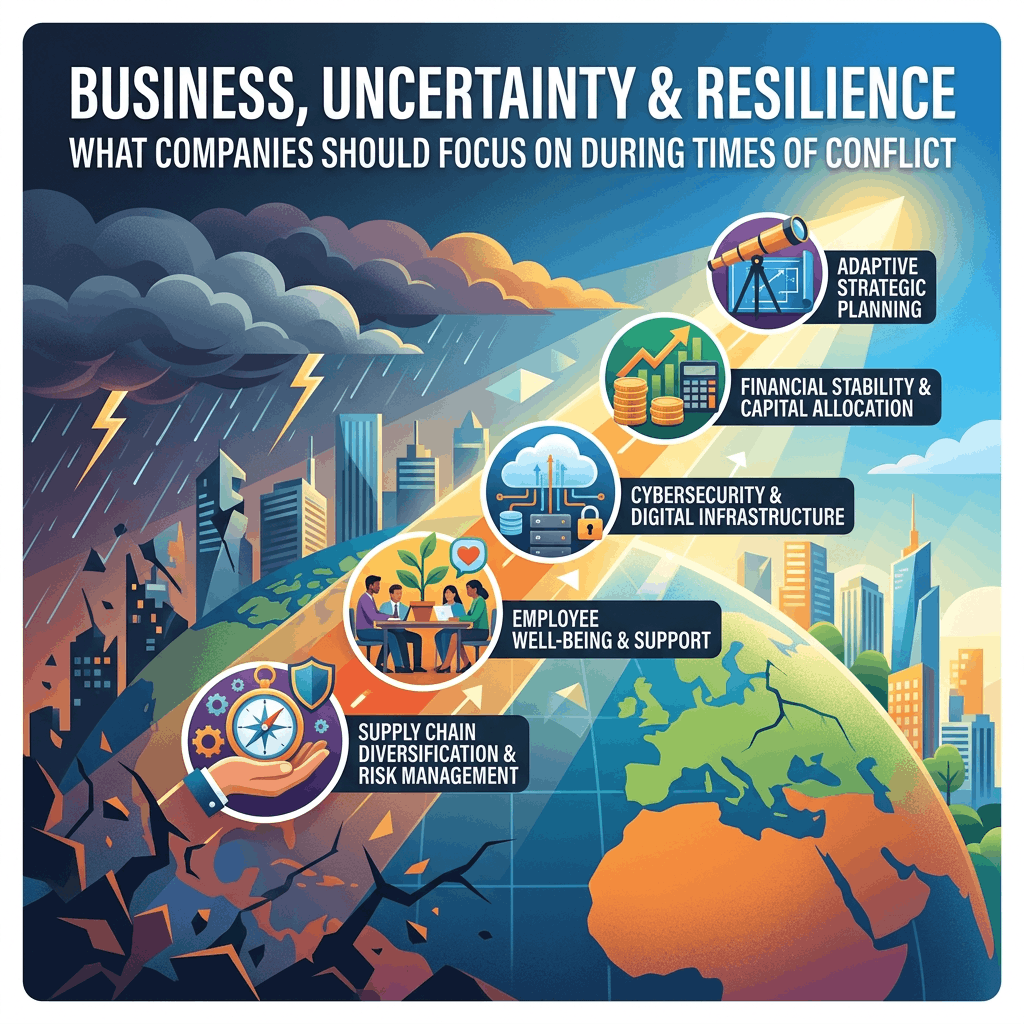
In times of regional uncertainty, questions naturally arise—about markets, industries, human behavior, and the future of business itself.
From conversations in offices to boardrooms, many are asking:
- Which industries remain stable during conflict?
- What should businesses focus on right now?
- How does uncertainty impact growth and decision-making?
- Why do global conflicts continue despite their costs?
While these are complex questions, one thing is clear—business doesn’t stop. It adapts.
Which Industries Tend to Be More Resilient?
Historically, certain industries continue to perform—even during instability—because they are tied to essential human needs.
These include:
- Healthcare & Pharmaceuticals – always in demand
- Food & FMCG – daily consumption doesn’t stop
- Logistics & Supply Chain – critical for movement of goods
- Technology & Digital Services – increasingly essential in all conditions
- Energy & Utilities – foundational to economies
On the other hand, industries like luxury retail, tourism (in affected regions), and large-scale investments may slow temporarily—but rarely stop entirely.
For businesses, this highlights an important reality:
demand shifts—but it never disappears.
What Should Businesses Be Looking At Right Now?
During uncertain times, the focus naturally shifts from aggressive expansion to smart sustainability.
Key areas businesses are prioritizing include:
- Cash flow and operational efficiency
- Customer retention over new acquisition
- Digital presence and online visibility
- Brand trust and communication clarity
More importantly, businesses are asking a different question now:
“How do we stay relevant?” instead of “How do we grow fast?”
Understanding the Impact on Business
The impact of regional instability is rarely uniform. Some common effects include:
- Slower decision-making from customers
- Increased caution in spending
- Shifts in priorities (value over luxury)
- Temporary delays in projects or investments
However, alongside these challenges, there are also opportunities:
- Less crowded advertising space
- More attentive audiences
- Greater demand for clarity and reliability
Businesses that adapt their messaging and strategy often find themselves better positioned once stability returns.
Why Do Conflicts Continue Despite Their Costs?
It’s a question many people ask—especially in times like these.
The reality is that global conflicts are shaped by complex factors such as politics, economics, history, and national interests. While individuals may question them, decisions are made at levels far beyond personal control.
For businesses and professionals, the focus is usually not on why conflicts happen, but on how to navigate their impact responsibly and sustainably.
The Workplace Reality: When Conversations Shift
It’s common during such times for discussions in workplaces to revolve around ongoing events. Leaders and teams naturally try to interpret what’s happening and what it means for their business.
The key is to channel that awareness into constructive action:
- Stay informed, but avoid panic-driven decisions
- Focus on controllable factors
- Align teams around stability and forward planning
- Maintain a balanced perspective
Where Marketing Fits Into All This
In uncertain times, marketing evolves.
It becomes less about aggressive selling and more about:
- Clear communication
- Trust-building
- Staying visible without being insensitive
- Helping customers make informed decisions
Businesses that continue to communicate thoughtfully are often seen as more stable and reliable.
This is where many companies begin to rely on strategic marketing guidance—ensuring their messaging aligns with the current environment while still supporting business goals.
Teams like DXB360 Marketing, for instance, focus on helping businesses maintain that balance—combining creative direction with market awareness to ensure brands remain relevant, even during challenging periods.
Stability Comes from Strategy
Uncertain times don’t eliminate opportunities—they redefine them.
The businesses that succeed are not necessarily the biggest or the fastest, but the ones that are:
- Adaptable
- Strategic
- Consistent in communication
While global events may be beyond control, how a business responds is always within its reach.
And in many cases, that response becomes the foundation for long-term resilience.